|
It’s been almost a year since I self-published my book, Life-Line: Origins through FriesenPress. The whole process was amazing. Since then, I’ve been focussing on marketing my book. I had a book launch here in Nova Scotia in May 2023 that went over really well. I’ve joined Reedsy Discovery, GoodReads AllAuthor and BookBub. I’ve posted a lot on my FaceBook and Instagram pages as well. I went to two book fairs here in Nova Scotia and made some great contacts.
The thing that I find the hardest about promoting my book is the sheer number of books out there. One area that I found the most curious was M/M romance books (male to male) - many of them are written by women for women. Even the LGBTQ sites seem to lean toward romance novels filled with m/m sex. I listed my book as a gay science fiction romance. It is a science fiction story first, but has a major romance between the two protagonists. How does one get the word out to the world that gay science fiction is something worth checking out? I recall having a conversation about gay sex in a science fiction novel. I asked my editor if I should tone it down for the heterosexuals who might read the book. She said absolutely not! It made me realize that I still had some internalized homophobia about not being worthy - after all, as a gay man, I’ve had to fight hard to be accepted. I have been asked by a straight science fiction reader why they should read a gay science fiction novel. I had a clear answer. For most of my life, I’ve read many sci fi novels and virtually all of them contained straight characters. I was in it for the story. I guess it comes down to the question: How does one challenge a potential reader to have a go at a gay science fiction romance? As most writers would say, I am very proud of my book. So how do I get the word out there? I’ve followed a lot of the sales information from FriesenPress and more. My FaceBook page has a little over 500 members, but it needs to grow. I get better results on my personal FaceBook page. Instagram seems to be doing well. My website visits are up over a thousand now, which is due to AllAuthor and Reedsy Discovery. The biggest negative that I’ve encountered are the hundreds of “book promoters” that have contacted me. For some strange reason, Nigeria seems to be filled with book promotors. Curious! I’ve had so many contact me, but virtually all of them are unable to tell me what their plans are, where their portfolios are and what is the clear cost. I am currently in the process of editing my second novel in the series, Life-Line: Diversions (the working title) and I am excited about it as well. The big question is, how will it be marketed? How will I get it out there? I love to write, but the marketing tends to take a lot of time away from my writing, as I am working full-time as a teacher as well. Here’s to hoping that I will find a balance and move forward. So I’ll say Carpe diem and onward I go!
0 Comments
As a gay man who’s fascinated with science fiction, I’ve read many books in my 60 years of life. Science fiction was my escape from the struggle of being gay in a small rural town. I read many authors such as Arthur C. Clarke, Isaac Asimov, Ray Bradbury, H. G. Wells, Jules Verne and many more. In their books, I found amazing adventures about travelling to the stars, living on strange planets and the evolution of man. Looking back, that was no small feat for a boy who read The Lord of the Rings at the age of 10. As I hit puberty, I was fearful of my real world, and being bullied in school, so books became even more important. It wasn’t until I left home at 17 that I discovered something that was missing in the science fiction books that I was reading: gay men. All the heroes were virtually white men and straight. I can remember a day in the 1980s when I was waiting for a bus to travel to see my parents and had a ton of time before I had to be at the Greyhound station. So I went book and music shopping on Yonge Street in Toronto. I found myself in a very large bookstore. I can’t remember its name but I remember the rows upon rows of books. I immediately went to the science fiction section and began looking through titles. I usually look at the title first, then the cover and finally the back cover. If it doesn’t grab me, then I move on to the next. I ended up finding a few interesting ones. Until I picked up one book. I had always been on the lookout for a book that might have a gay character in it. It wasn’t really something active, more in a passive, hopeful way. The cover of the novel had the Title of A Different Light by Elizabeth A. Lynn. I had no idea who she was. The cover showed a man running with a mask in his arms, a woman with big hair running with a tablet alongside him and then a guy behind who had a moustache, who was also running. The last man had some sort of weapon that he held at the ready. It must have tripped something in my mind as my hopes leaped as I turned the book over. It was about a man who was ill with what turned out to be cancer even though it had been eradicated. He was told he would live 20 more years if he didn’t travel outside of space-normal. But he was willing to risk it all to make the jump into the Hype, the shimmering "not space" for one year among the stars. So, I turned to the first chapter and to my surprise, the first page had a Jimson looking at an image cube of a man named Russell. The man in the image had emerald earrings and red hair. Jimson reacted to the image and I knew that there were gay characters in this book! On the bus home and onwards, I discovered pirates, lovers, psychics, and distant planets. I was in rapture! I remember reading it several times until I lent it to a friend who never gave it back. Several years later, I drew parallels to Jimson’s illness and HIV that was all around me. By the way, A Different Light was written in 1978 before the AIDS epidemic. I now direct the narration to 2016 where I wrote my first novel about gay men in space. My world of Tam, Brogan, mind reading, pirates and adventure was inspired by aspects of the novel by Elizabeth A. Lynn. I have mentioned in some of my other blogs that my novel started out as a short story about 10 years previous. It sat unseen for that long before I felt inspired to pick it up again and complete it. Even though I no longer had a copy of A Different Light, I recalled the descriptions of spaceports, transportation and space travel faster than light. The story arc also included a heist, people with mental powers and a crew of misfits on Russell’s ship. So, in my novel Life-Line: Origins, there are gay men, mind readers, pirates and sirens. I went from a claustrophobic short story about a man stowed away on a spaceship, trying to rescue his imprisoned partner to a whole universe in the novel. I loved writing my novel so I thank Elizabeth A. Lynn for inspiring another LGBTQ+ author to write science fiction with gay characters in it. In my next few blog entries, I’ll be writing about the characters in my novel such as Tam, Brogan, Captain Farthing, Anghelloise and Bennett. I won’t be forgetting the bad guys too! 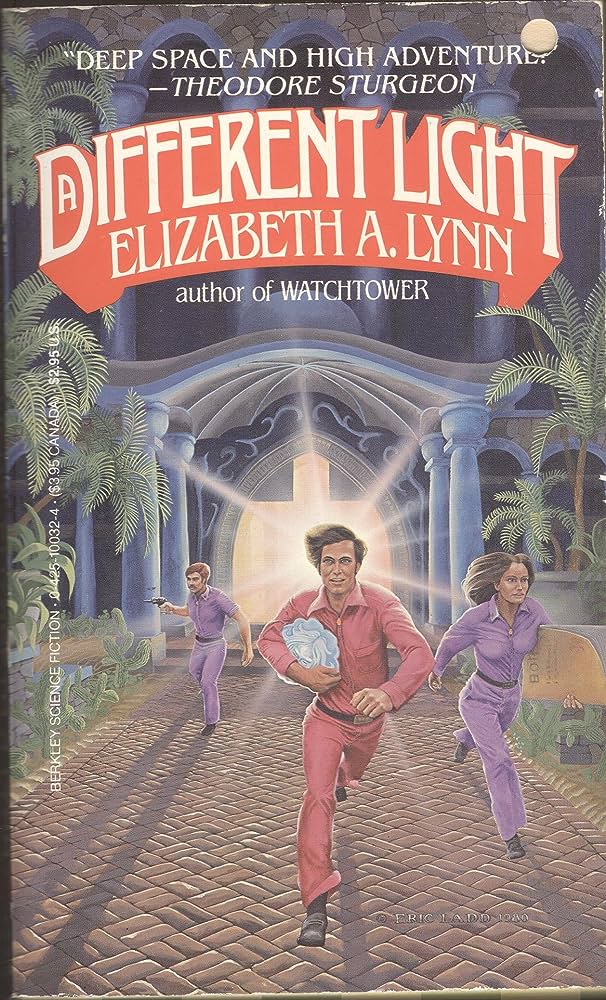 In March of 2009, I picked up a brainstorm that I had written down years before about a man stowed away on a spaceship. It was meant to be claustrophobic and not to be anything but a short story. It came about after reflecting on a few past relationships where I began to explore the idea that relationships could be based on love. The overriding claustrophobia was meant to represent that I was being pigeonholed into being something other than my true self. I had just gotten out of a very difficult breakup with a man who became a drug addict. I had, in fact, felt very claustrophobic in my own house.
The story is about a man stowing away and how uncomfortable he was. I felt that it asked the question, “How much would someone do for the person they loved?” As an aside, it contained a rather abrupt flashback. It was later turned into a separate chapter of its own, once I decided to pursue writing the book six years later. Here are two excerpts from the short story and my actual novel. I can’t believe the difference! I’ve really grown as a writer and discovered how useful an Editor is! The first is part of the short story: “The vibrating took a new whine, indicating a service stop ahead at the next hyper station, when the ship would jump out of subspace and jump back into real space, next to a hyper station for recalibration, and computer link up to confirm proper passage and proper calculations to continue the jump through the hyperspace to the next hyper station. The ship shuddered and the vibration increased to a low whine that gently grate on Steven’s nerves as his whole body vibrated in tandem with the ship coming out of hyperspace and into reality. Reality was hard. He would always feel reality hit when the ship came through the last throes of hyperspace. As the ship did right now – sliding into real space. Reality hit him hard and he cried a muffled cry of pain and anguish. How would he get through this? How could a farmer from Nigel hopefully succeed in rescuing his male love from the prisons of Antares 4? The place was where all degenerates were sent when they were caught. I’ll be caught too! I could die there as well as Tony. Better dying by his side, than alone at home, wondering if he could do anything at all. You’re just a farmer, Steven. Not a hero. You must not forget though what the siren mother at the church said about the Loveline that connects you to Anthony. He is my soul mate. My life is forfeit if he dies, so go I must to save him or die trying.” This is from my novel: “The vibrating ship had taken on a new whine. The ship was dropping out of curved space and slowing down to a stop at the latest curved space pylon. This would be one of nine times that he would have to experience the madness. Corustloth had a very long, elliptical orbit in relation to the other planets in the system, hence the need to have nine pitstops on the way to the prison world. Curved space made the voyage easier than regular space, but it was maddening to experience each time the ship dropped out of it. Too bad it couldn’t be done in one quick jump... The ship shuddered and Tam’s whole body vibrated in tandem, shaking pleasant memories of Brogan out of his head, insisting he wake up. Again, he had to experience this awful feeling like a slap across the face. It must have been something to do with the ship’s mechanics, the reason he almost went insane each time they dropped into normal space. One of the negative aspects of being a Life-Liner. He swallowed and fought the urge to be sick. Dreams forgotten, his dubious plan was at the forefront of his mind. How could he somehow succeed in rescuing Brogan from the prison on Corustloth? He quickly turned on his side, bringing his knees closer to his chest so that if he were to be sick, he would have enough time to pull an emergency bag from his satchel.” The original characters were named Steven and Anthony and they lived on Nigel instead of Alorion. As I began to think about making it into a novel, I realized that I had to plan out a whole set of worlds in the Messier 100 Galaxy, instead of in the Milky Way. Planet names were researched and I came up with Tam and Brogan for the main characters and the worlds Alorion and Corustloth. There was no indication of skin colour in the short story. When I started the novel, Tam automatically became a person of colour as it seemed right. Other differences were that a Life-Line was a Loveline and the Senate replaced the Empire, which was too much like Star Wars. I also ditched hyperspace and subspace because of television references. A friend gave me the idea of using curved space as an alternate name for being able to travel faster than normal space. Curved space was meant to show an acceleration but below light speed. There was no mention of mental abilities in the short story. Their souls were joined but that was never developed. One day, I began to think about mental abilities as a friend and I were talking about “Gaydar.” For those not in the know, Gaydar was that feeling you got when you saw another gay man - you seemed to sense him. I recall that this was the way to find another gay man in a more unfriendly world. One thing writing the novel allowed me to see is that drafts are just that. Stories need to be rewritten, retooled, and changed. My editor at FriesenPress was invaluable. They really taught me a lot about my writing. I also realized that I have been saying the same things to my elementary school students about their writing: run-on sentences, dangling participles and prepositions at the end of a sentence, etc. What a learning experience for me! Doing my first novel was a gateway to learning how to write better and has made me much more comfortable as I complete the second novel in the series potentially entitled, Life-Line: Diversions. Carpe diem! My first blog posting.I am incredibly excited to be at this point in my publishing! It has been a long and sometimes arduous road. In 2009, I never thought that my short story would become something more - that I would eventually publish. I thought that I would thank all the people that helped me get to where I am today. |
